

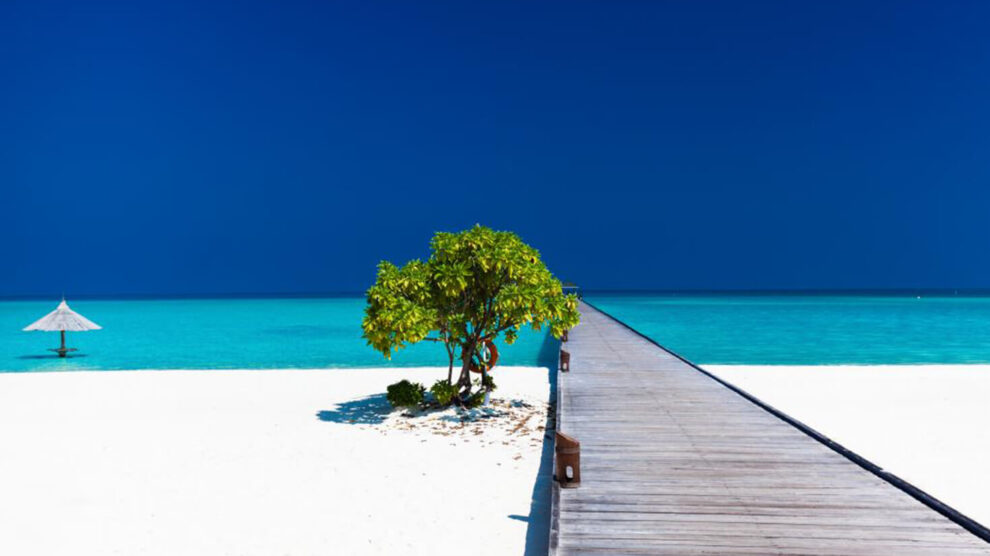

Indulge all your senses in the beauty of the Maldives with its breathtaking sunsets, white sandy beaches, rich Islamic history, and amazing seascapes of coral reef. Located in the Indian Ocean, this South Asian nation’s unique topography of 99 percent ocean and one percent land (only 298 km2 of land) makes for a spectacular experience.
Spend your days lounging on the beautiful beaches or exploring the underwater mountain ranges at one of the 1190 islands that are encircled by protective reef structures, ensuring waters are lagoon-like and crystal clear. Known for its friendly Muslim population and halal resorts, visiting this picturesque part of the world makes for an amazing family getaway, a romantic honeymoon or anything in between.
History
Prior to adopting the Islamic faith in 1153, Maldivian history is vague, with historians disagreeing on the facts. One prominent theory is that the Maldives was an important trading junction for many great civilizations including the Egyptians, Romans, Mesopotamians and Indus Valley traders. Around 500 BC it is considered to have been absorbed by the Sri Lankan Buddhists and Hindus from Northwest India. The adoption of Islam followed a ruling by the King who converted at the hands of Adul Barakat, a north African Arab (though some consider him to have been Persian).
The crucial geopolitical position of the Maldives has meant that it was able to retain internal autonomy whilst remaining free of external threats by accepting the protection of the Dutch, entering into a defence treaty with the French and maintaining good relations with the Britain, especially after they took possession of Ceylon (now called Sri Lanka) in 1796. In 1887, the Sultan entered into a formal agreement with Britain declaring the Maldives as a British protectorate. On 26 July 1965 an independence agreement was signed with Britain, recognizing the Islands as completely sovereign and independent.
The Islands fluctuated between a Sultanate and a republic for the first half of the 20th Century. In 1978 Muamoon Gayoom took the Presidency, remaining in office for 6 terms – 30 years. His presidency was mired with controversy. On the one hand he bought prominence and wealth to the islands through his focus on tourism and trade. On the other he violently curtailed any political and even civil dissension to his rule – with reports of torture, mass beatings and solitary confinement. Despite free elections in 2008, the election of current President Abdulla Yameen (President Gayooms brother) in 2013 has led to civil unrest and corruption scandals. Despite this tumultuous internal workings the Maldives remains a favourite tourist destination.
The Maldives has a diverse culture that is mostly influenced by South India and Sri Lanka. Since the 12th century, the island nation has had a huge influence from Arabia which is still visible in the language and religion of the country. There are also a few elements of African origin from people bought as slaves to the island nation to serve the royal family, and nobles who stopped over on their way to the Hajj journey in Arabia. Most of today’s population are Indo-Aryan, and are entirely of Muslim faith.
Food
With a 100 percent Muslim population, most hotels, resorts, restaurants, and even street food vendors are halal. With the fishing industry being the second largest in the country, tourist can expect some of the finest seafood and some of the freshest fish you’ll ever try. With very little land for farming, most of the Maldives fruits and vegetables are imported, especially the food served to tourists at resorts.
Traditional Maldivan cuisine is based on coconut, fish and starches such as rice. Take a traditional breakfast with Mas Huni, a dish of finely chopped tuna, onion coconuts and chilli and eaten with freshly baked rosh flatbread. One of the best ways to sample the fresh fish is with the mouth watering Fihunu Mas; barbecued fish basted with chilli. For dessert, try Maldivian sliced justard, or as its locally known, Bis Haluvaa. Made with ghee, sweetened condensed milk and eggs this chilled dessert is the perfect ending to a locally inspired meal.
Just Veg
Just Veg is in Male, a purely Vegetarian restaurant, a first in the Maldives, it serves delightful vegetarian cuisine from the Mediterranean, Arabic, Indian regions along with a special menu specifically for Jain Cuisine. Try their citrus asparagus salad, with green asparagus and soft tofu salad, mung bean sprouts, heart of palm, grapefruit segment and seasoned with citrus soya dressing. The sweet and sour Manchurian vegetable in its warm gravy served with a crunchy katchumnbar vegetables medley is a stunningly simple appetizer. For your main meal, try the Baron bride eggplant; aubergine fritters topped with creamy mushroom persillade and cheese au gratin egg plant baba ganoush and roasted cherry tomato. For nutella fans, the Nutellamisu dessert is simply scrumptious; light and egg less twist of tiramisu with mascarpone froth, nutella, banana and cashew brownie, accompanied with a refreshing Just Veg herbal shooter.
The Sea House
Close to the jetty, with a great view of the ocean, the Sea House is a great little cafe to sit and relax on an open deck over a well priced meal. Plan your visit for just before sunset to ensure a breath taking view backdrop. The Sea House offers a variety of cuisines; Indian, Pakistani and Dhivehi. Enjoy a simple meal or Dinner buffet, the sea house provides variety and simplicity.
Attractions
National Museum
Opened on November 11, 1952, on the National Day of the Maldives, the National Museum was built with the purpose of preserving the history of the Maldives and instilling patriotism in the people of the island nation. The museum has two section – an upstairs section which includes modern period displays such as Maldives lacquer-work boxes, while the downstairs section has displays from the ancient and medieval periods of Maldivian history. In 2012, the museum was sadly broken into by religious extremists who stole 30 ancient Buddhist coral stone carvings and destroyed them for being idols.
Mulee-aage Palace
Within walking distance from most of the main attractions in Malé is Mulee-aage Palace which was once the Official Residence of the President of the Maldives. Built in the early 20th century for the sultan, it was never lived in as he was deposed before it was complete. Since then it has had many uses, including the Residence of Crown Prince Hassan Izzuddin, the Ministry of Home Affairs, the Presidential Palace, the Prime Minister’s Office, and the Supreme Court of the Maldives. Today, it is used as the Official Residence of the President. Although visitors are not allowed inside the building, the beautiful architecture is a sight to behold during the day; and the grounds serve as a gathering place in the evenings, with stunning light displays and a family oriented jovial atmosphere.
Natural Wonders
HP Reef
Just off the coast of Furanafushi Island in the North-Malé atoll is one of the most incredible scuba diving spots in the world called HP Reef. Located next to a narrow channel, strong currents feed the reef causing it grows blue soft corals and have an abundance of sea life; HP Reef is truly an eyeful. With large formations, stunning caves and a 25 metre swim-through chimney, this protected marine area is definitely a place for experienced scuba divers to go diving.
Hithadhoo
Located in Seenu Atoll is the capital Hithadhoo. With lush forests, beautiful beaches, and warm waters, this area in the westernmost part of the atoll is the perfect place to escape. Luxury resorts like Six Senses Laamu, Amra Palace, and Maalifushi line beachfronts giving visitors a secluded and private beach getaway experience. Hithadhoo is also known for its English speaking locals, garment factories, and excellent telecommunication facilities like Wi-Fi and cellphone reception.
Mosques
Malé Friday Mosque
Located opposite the Medhu Ziyarat, tomb of Adul Barakat Yusuf who led the Maldives to Islam, is the Malé Friday Mosque. It is one of the oldest, dating back to 1656, and one of the most ornate mosques in the city due to its unique sea culture architecture. Malé Friday Mosque was built with coral boulders and became a UNESCO World Heritage Site in 2008. The impressive religious building also has a beautiful interior with intricate decorations and scriptures from the Quran on the walls. Adorned with intricate wood carvings and beautiful lacquer work the interior is a sight to behold. Tourists who want to see the inside of this mosque need to get permission from the Ministry of Islamic Affairs located at the Islamic Centre (though this can usually be obtained at the door) . This mosque is open to visitors throughout the day except during prayer times as it is still in use.
Islamic Centre
The Islamic Centre, also known by its official name of Masjid-al-Sultan Muhammad Thakurufaanu Al Auzam, is an architectural landmark in Malé. Opened in November 1984 by President Maumoon Abdul Gayoom, the centre is home to the Ministry of Islamic Affairs, an Islamic library and the Grand Friday Mosque – which is one of the largest mosques in the Maldives and Southern Asia catering to over to 5,000 people. The stunning crisp white architecture of the centre contrasting with gold features has become a major tourist attraction in the capital of the Maldives, Malé.
The Grand Friday Mosque
Built with the help of Pakistan, Brunei and Malaysia, the Grand Friday Mosque was opened in 1984. Housed within the Islamic Centre, the golden dome of the Grand Friday Mosque is the most dominant feature of Malé’s skyline and can be seen from the harbor. For years the dome was the tallest building until the title was taken by the telecommunication towers. Inside the mosque you’ll find intricate wood carvings and Arabic scriptures on the walls, a massive contrast from the stark white walls outside. The mosque is open to the public to view between 9am and 5pm, except during prayer times when it is closed to non-Muslims.


Add Comment